Pages

Showing posts with label Cornie Hubner. Show all posts

Friday, July 20, 2012

Didja Know? The Smoke Rise Green House

Didja Know? The Smoke Rise Green House
Here, from Cornie Hubner's marvelous "Didja Know?" series, an article about The Green House in Smoke Rise.

-----

The Green House located on the John Talbot Estate once provided, all year, fresh flowers, fruits and vegetables for "The Cottage," home of the Kinneys.  Designed by Lord and Bernamin, famous landscape architects, in 1904, it consisted of six, 500 ft. square, connected glass buildings heated by coal and wood burning furnaces. As a hobby of the younger Kinney, Morris, it soon enjoyed popular interest.

Supervised by an experienced English gardener (enticed from a Long Island Estate), each unit provided the required conditions for different, unusual and often exotic horticultural experiments. Neighbors were welcomed to marvel at the all year harvest of flowers, fruits and vegetables. It is possible that some local gardens still contain a hybrid phlox that Morris distributed when an experiment produced blooms that he did not like.

The Hot Houses of his many friends provided transplants that brought trees and bushes to early fruition. Figs, oranges, nectarines, grapes and berries were among the off season ripenings. Roses, orchids, lilies and among others a rare red flower, clivia, formed centers around which all kinds of cut flowers were grown. Vegetables were raised in two sections, augmenting the available supply during World War I. Annual flower plants were grown for early spring planting at the "Cottage" and transplants for the vegetable garden outside the Green House assured early crops of all vegetables.

At one time the stellar attraction was a fig tree reaching to the ceiling with lattice like branches spread over an entire wall. It was rumored that each of the 200 cuddled figs actually had names.  The was almost confirmed by the furor created when one fig disappeared. An intensive investigation exonerated all Estate employees when the mystery was solved by the confession of a delivery boy, unaware of the enormity of his crime.

Two generations of the Dumper Family occupied the apartment over the garage and supervised all seasons productivity until the mid '40s. A unique grape, grafted on local stock and the result of many trials rewarded the experimenters when it ripened during this time. It was the headliner of the Estate's many exhibits at important shows that attracted the interest of commercial and amateur growers.

The Ray Moody family took charge after World War II and continued with gradually reduced plantings until 1979.  Part of the capacity was used for several years, by a grower for raising Taxus seedlings. Many thousands were transplanted in nearby nurseries to protect the succulent needles, greatly enjoyed, for dessert by our always hungry herd of four legged friends.

One of the original sections is still operating and "Cotswold" is enjoying flowers and the many annuals that bring brilliance to the sunken gardens and sunkist lawn on the lake.

-----
Pretty wonderful, no?

Monday, December 26, 2011

Didja Know? Smoke Rise Christmas Celebrations

Here is Cornie Hubner's "Christmas Celebrations" from his Smoke Rise Didja Know? series.

Christmas Celebrations


The 1947 Christmas Season Celebration for the two resident Club families was magnanimously provided by bountiful Mother Nature with a three-foot mantle of unblemished crystals that covered the land and turned every tree into an original decorated masterpiece glistening in the sunshine. Relatives, friends and soon to be residents traveled poorly plowed State Highways and untouched Country Roads to reach an unexpected five miles of perfectly cleared roads that led oto the occupied homes and the several buildings under construction.

It was truly a winter wonderland, a dazzling Christmas Card vista that had delighted the Kinneys and their friends almost exclusively (except for the few brave poachers) for many years. The view from the Cottage on the Lake brought a miniature Switzerland to their doorsteps. Indoors a huge, beautiful Christmas Tree, surrounded by stacks of colorful packages provided the Lord of the Manor with a regal setting for the distribution of gifts for the family, friends and members of the staff.

The Franciscan Monastery in Butler provided the Celebrant for the Mass offered in St. Hubert's Chapel on the island when the ice was thick enough to offer safe passage for the worshipers. It was heated by a huge wood burning stove and a fireplace in whose flickering light the gem-like interior presented a  picture of medieval splendor matched only by the private chapels of European Nobility.
(At this point you should be reminded that concentrated effort by dedicated members, implementing the restoration plans long dormant, is needed to restore this one of a kind jewel or at least save it from its continuing deterioration. Tom Kline, a former Smoke Rise resident, has devoted time and money for many years in a losing battle to "hold the line." He, now living at No. 3 Sabeys Beach Road, Kinnelon, 492-2620, would be very happy to explain his plans and welcome your assistance. See "Didja Know" December 15, 1985.)
By Christmas 1949, some 35 hardy pioneer families were located in comfortable homes on over ten miles of gravel roads. One of the early members recalled his first, never to be forgotten, leadership of a group of carolers whose limited talents were offset by its enthusiasm.  His gradually freezing fingers produced the music that covered the off key voices and achieved a genuine welcome in home after home. The exhausted well wassailed songsters made a last scheduled visit, to enjoy a reviving repast, little realizing they had established a prototype for the Christmases to follow.

No, not from Smoke Rise. Rather, the
Rockefeller Center Tree in NYC
The Inn provided the limited area in what is now the Meeting Room for the first formal New Year's Eve Ball with dinner in the area now occupied by the Reception and Cloakroom at the all inclusive cost of fifteeen dollars per couple. By the end of 1950 it was realized that the facilities were inadequate and a roof was built over the patio to join the Inn to the Cow Barn. This previous home of the prize brown Swiss herd, with a low ceiling and many iron pipe supports for the haymow above, after almost fifty years of disuse, became the White Room, in time for the 1951 formal New Year's Party.

Used for Club Meetings it transformed into a place of Worship for the growing Community Church every Sunday, when the organ, vestments and hymnals miraculously made their appearance. It sometimes required the frenzied efforts of the parish to remove evidence of the previous night's party and ride the air of the aroma of the liquid refreshments served. This continued until 1956, when the Church built on three acres donated by the Company was consecrated.

From the beginning, J. Alden Talbot, then also president of the American Ballet Theatre, encouraged the formation of the Clubs now functioning. He sponsored the formal Christmas Tea, at which his invited hostesses "poured" using their own silver services that they were proud to display. Interest was created by his guests that at one time included the entire Sadler Wells Ballet, Russian Nobility, and opera stars. The many teas that followed culminated each year at the Women's Club, Garden Club Tea where the Greeting Fund distribution started in 1966. That year the Fire Department and Tri-boro first divided the approximately $1,800 raised. Twenty years later, $30,000 was shared by thirteen charities with about $7,000 each to the original recipients.

Cocktail dances and the New Year's Eve Formal, with well known orchestras (a Lester Lanin Society Unit at one time) were being oversubscribed. By 1960, the full course dinner was priced at $4.50 (including a shrimp cocktail) and the full treatment $10.00 included breakfast.  By 1973, the White Room and the two rooms in the Inn were needed for over 200 at the cost that had risen to $20.00.

The Season was always inaugurated by Mr. Talbot with the lighting of the Christmas Tree at the Inn. Events for the children that featured Santa Claus, Cotillions for High School students and formal dances for College kids began in '57.  The following year an Outdoor Decoration Contest added a new activity to the growing schedule. All Club functions transferred to the Community Church in '77 and formal dances were held at the Rockaway River Golf Club until '81 with gala opening of our present facilities.

Following the period from 1924 when social activities ceased, until the Smoke Rise Club started in 1957, the last forty years have been a period of phenomenal growth and increasingly rewarding activities as evidenced by the thirteen active Social, Religious, Educational and Athletic Clubs now available for the benefit of the more than 800 families of its members.

Merry Christmas & Happy, Healthy New Year 2012!


Sunday, October 9, 2011

Our Lady of the Magnificat: Didja Know? by Cornie Hubner


Cornie Hubner: Didja Know?
I'm overdue for a story from Cornie Hubner. My excuse is that Emma and I were waiting for a beautiful sunny day to take photos of the OLM Chapel. Here is Cornie's Didja Know? article about Our Lady of the Magnificat, in Kinnelon, which he wrote when OLM was celebrating its 25th Anniversary. Fitting to share it with you as OLM celbrates its 50th Anniversary [see OLM: Looking for Founding Parishioners].

Our Lady Of the Magnificat

by Cornie Hubner

St.Hubert's Chapel, in the lake, was the first consecrated Roman Catholic place of worship in Kinnelon in 1886. It was the private chapel of the Kinney family, served by the Franciscan priests of St. Anthony's Mission of which the few local families were communicants. It was not until 76 years later, in 1962, that the first official mass was celebrated in the newly formed mission of Our Lady of the Magnificat. It was named after the gospel of St.Luke, "My soul doth magnify the Lord," by Henry Wise Miller who donated the Chapel buildings and land to the Diocese of Paterson in '54.

Our Lady of the Magnificat Chapel, Kinnelon - 1
The acreage, part of parcel owned by Robert Morris in the early 1700s, was purchased by Miller in 1925. Nationally recognized in his own right, Henry numbered among  his ancestors a descendant of an officer in Wellington's command at Waterloo, George McCullough, the designer and builder of the Morrris Canal, an early president of Harvard and the last Whig U.S senator. He designed and built three stone houses, in one of which he reassembled the Captain's cabin of an old four master. Its exquisite walls were a fitting background for his priceless collections.

Our Lady of the Magnificat Chapel, Kinnelon - 2
Shown only to close friends, his jades, loosely fondled by the lucky ones, left them breathless when they later learned the value of what they had been privileged to handle. The collection of silverware, represented the artistry of every continent. As a dealer, he maintained contact with others by mail and the exchange of 8x10 photos, sometimes taking up to a year to exchange or purchase a unique or historic masterpiece. His book on the subject was a bible for the trade.

Our Lady of the Magnificat Chapel, Kinnelon - 3
Following a politically doomed business expierience in Brazil, he pirated thousands of rubber tree seedlings for planting in Cuba. There, shortly after the Spanish-American war, he started a plantation at the eastern extremity of the island. After several years it was apparent that nature would not cooperate and he transferred his unbounded energy to a succesful Wall Street career. This led to his marriage to a famous socialite author.

Our Lady of the Magnificat Chapel, Kinnelon - 4
Alice Duer, his first wife, a descendent of the defender of New York City, one of Washington's trusted officers, and two early Colombia University presidents, was born on a large estate on the bluffs overlooking New York City. After several successful novels, she turned her talents over to poetry. Her "White Cliffs of Dover" became an international sensation. It had 33 editions and sales of 700,000 that made it unique in '45. Read by Lynne Fontaine to the accompaniment of an original scored symphony it started a trend popularizing many records for home enjoyment.

Our Lady of the Magnificat Chapel, Kinnelon - 5
Henry loved his wife dearly and attempted to share his feelings in his book "All Our Lives," published in '45 after her death. Two English Copper Beech trees, which he accompanied from England, were planted for her, in the 20s at the then rumored astronomical cost $750.00 each. They prospered and added the open English countryside touch to the area where the Chapel was built.

Modeled after an ancient church that he had seen in Harescombe, England, Henry corresponded with church authorities until he completed the plans from which the edifice was built. In failing health, he was carried on the crossed hands of his workers, to surpervise its daily progress until completion. Affirmed
in the Catholic Faith, he died shortly after and his funeral Mass was the first in his beautiful Chapel.

Our Lady of the Magnificat Chapel, Kinnelon - 6
From 1954, the Diocesen Estate, with its Chapel and buildings was in the custodial supervision of the Order of Salvadorian Fathers. The Polish Prelates transferred to their Gary, Indiana headquarters in 1961 when Fr. John R. Ryan was assigned to the newly designated Mission. On his arrival, he wondered what he did wrong to warrant his banishment. Now, as Monsignor, he wonders just what to do to remain. With the help of a sympathetic family and encouraging welcoming parishioners, much was quickly accomplished.

Our Lady of the Magnificat Chapel, Kinnelon - 7
The first Official Parish Mass was held in '62. The Chapel was soon bursting with worshippers frequently obliged to participate in open doors and windows (a bit discouraging in rain and freezing weather). The need for expansion forced the construction of a school with a large auditorium that could accomodate the ever
increased attendance at several Masses. The first class entered school in '64 when the first Mass was celebrated.

Our Lady of the Magnificat Chapel, Kinnelon - 8
The Cemetry was opened in '65 and a drive for Church started in '70 culminated in '73 with the dedication of the beautiful monument to the faith and loyalty of congregation. Father Ryan, now Monsignor, with his associates Pastors William J. Mooney and Richard J. Messenlehner, provide for five Sunday and one Saturday evening Masses for the 850 families in the parish. The Sisters of St. Joseph of Chestnut Hill originally staffing the first four classes, now supervise eight classrooms, a Kindergarten and Pre-Kindergarten.

Our Lady of the Magnificat Chapel, Kinnelon - 9
The 25th Anniversary will be fittingly celebrated later this year when a more detailed history will be published. "Our Lady of the Magnificat" will always be an influence for good, that parishoners and the entire community are thankful for and wish continued success.

~Cornie

----

Thank you, Cornie!

Here are a few more photos that Emma and I took when we visited Our Lady of the Magnificat's Chapel.

Our Lady of the Magnificat Chapel, Kinnelon - 10


Our Lady of the Magnificat Chapel, Kinnelon - 11

We love closeups of stone. Marvelous texture and color, don't you think?

Our Lady of the Magnificat Chapel, Kinnelon - 12


Our Lady of the Magnificat Chapel, Kinnelon - 13

Special thanks to Emma for typing up Cornie's article.

Saturday, February 19, 2011

The Smoke Rise Riding Club - Didja Know?

Didja Know?
John Connelly's recent story about Beatrice Kinney and Horses reminded me that Cornie Hubner had written a Didja Know? column about horses, Smoke Rise and the Smoke Rise Riding Club. I share it with you here....

Horse Show

The reopening of the stables in '62 unleashed an unexpected pent up interest in riding.  Several riders had stabled their mounts for five or six years in facilities just ouside the Smoke Rise East Gate, on Fayson Lakes Road.  These were the charter members of the Riding Club that numbered 150 at its peak. The tremendous interest by a majority of juvenile novices, brought a response in Club activity.

A stable of 17 teaching and rental "hacks" under the direction of a retired cavalry officer, provided the aspiring riders the means for lessons and practice.  The first improvised rings were laid out and a local invitational show of limited scope was scheduled.  Most of the novices took part as the accomplished riders demonstrated their techniques. The show was an outstanding success that led to a Class "B" membership in the American Horse Shows Association.

Fortunately, increased membership and finances provided the labor and material to meet the stringent Association specifications.  Many volunteers together with Company equipment, some donated and purchased materials, prepared three rings for practice and competition.  The Smoke Rise grounds with the 25 miles of trails offered one of the most beautiful settings in the East. All was in readiness for the 18 successful Association shows that followed.

With its white fences, judges stands, inside and outside jumping arenas, the acreage provided by the John Talbot Estate had the delicate water color picture look of the sporting English countryside. The equipment had to be manned by qualified personel for all formal shows. Judges, Stewards, Ringmasters, a Veterinarian and a Farrier were chosen from Associaton approved lists and engaged far in advance for adequate fees. These obligations were assumed by the hardy group of devotees and the shows went on to increased participation and enthusiastic spectators.

Parking areas in the ball field and along adjoining roads were provided for over a hundred trailers. These extended from a simple one horse trailer to an elaborate four stall, tack room equipped equine mansion. The camaraderie around their campfires was reflected in the clean competitive spirit shown in the ring.

Early shows somehow always managed to run without apparent trouble. Crises were overcome. One time, unable to make up for delays, darkness fell before the day's events were completed. No field lights being available, all the cars were lined up and the program was completed at the expense of some weakened batteries. The modern lighting system was installed before the next show.

As the popularity of the shows increased, riders were attracted from the tri-state area and as far away as Virginia. Among the notables who were repeaters were Doc Severinsen [of TV fame] and his two children, Mitch Miller [of Sing Along] and his son, and Melanie Smith, a member of the U.S. Equestrian Team. The three Leone brothers of the Grand Prix Jumper Tour [the pro golf of riding] where occasional guests of members.

The impact of demonstration by these and other outstanding riders had its effect on our youngsters.  Discipline and dedication, to the exclusion of other diversions, produced outstanding pupils for instruction by the best teachers in the country.  Competing in both indoor and outdoor shows earned thousands of ribbons and sufficient points to quality for the ultimate goal - to compete at the National Madison Garden Horse Show.

With the exception of  Mrs. Ward, these riders who appeared in at the Garden began in Smoke Rise.

Paul Rose captured the Junior Working Hunter Championship on "Gozzi."  His nationally recognized mount, once the terror of competition, was thought to have "passed its peak."

Diane Nifosi on "Russian Caviar" placed third overall in the Amateur Owner Hunter Division. Continuing on a reduced schedule she has been a member of her college team.

Gregory Casey rode "Waverly Lane" and placed in several events. College has limited his riding to occasional shows.

Diane Brady Ward had several years' training before moving to Smoke Rise. She rode "Traveler" [the "Horse of the Year"], placing from 2 to 6 in the Open Jumper classes. Both of her children rode, two days before they were born [?], and her daughter has followed mother who still rides and trains.

Participation by riders like these raised upward of $5,000 for charity at the Annual Show.  Despite the dedicated Club Members and the Chilton Hospital Volunteers, costs of $15,000 rapidly rising, ended the popular performance in 1972.

The active Smoke Rise Riding Club maintains all facilities and offers membership to all.

----------------

The Smoke Rise Riding Club

As Cornie mentions in his closing paragraph, the Smoke Rise Riding Club remains active to this day.  

Here is a description of the club from the Smoke Rise Riding Club About Us page:

"The Smoke Rise Riding Club was founded by John Talbot and other Smoke Rise Residents in 1963, and incorporated as a non-profit organization in 1965. Until his death in 2006 Mr. Talbot remained active in the club, as a Trustee. Horses at Smoke Rise are stabled on his farm. Today The Smoke Rise Riding Club in an independently funded, non-profit, sub-club in the Smoke Rise Community open to anyone interested in stabling horses, taking lessons, competing in equestrian events, or riding for pleasure at Smoke Rise farms."

And further detail:

"Over the years, some of the premier New Jersey horse shows were held here, in the Village Green riding rings and surrounding fields. The club was active until the late 1970s, and was revived in the early 1990s. During the last few years, the club has been building its membership and its show schedule. The club now hosts eight C-rated USA Equestrian shows, and several local shows. The Club's philosophy is to instill self-confidence, self reliance, and maximum responsibility for the horses well being with each rider attending to their own tack and to the horses needs..."

For more information, visit The Smoke Rise Riding Club website.

For those of you who have been active in the Smoke Rise Riding Club, I'd love to hear your stories!

Sunday, August 1, 2010

Skiing In & Around Smoke Rise & Kinnelon

Cornie Hubner's Didja Know?
I realize that it's deep summer and not exactly skiing in New Jersey weather.  However, Elizabeth Holste, former Kinnelon resident and author of Skiing in New Jersey, recently contacted me asking about the Smoke Rise ski trail. I remembered that Cornie Hubner had written about it. His story addresses skiing in & around Smoke Rise and Kinnelon.

Didja Know?? - Skiing

The almost 400 ft. vertical drop from its high point, to the Pequannock River made it perfectly obvious to Alden Talbot, that the road should be names Ski Trail. Recognizing its value, the Smoke Rise Corp. allowed a 50 to 60 ft. corridor between lots #399 and #401 to provide access to a ski run.  This strip, purchased by the adjoining resident in 1968, is still shown separately on the "Not to Scale - road map" of 1988.  The opportunity to advertise this rare facility was not overlooked in brochures and publicity of the first years of the Clubs development.

The 5,000 acres "Created by Nature - Preserved by Man" was offered to the classified 20% top income families identified in the October 1947 New York Herald Tribune as "willing to pay $35,000 to $40,000 for a home and having a minimum income of $7,000". (Didja Know 8/15/85), when the average family earned $3,000.  "To those who admire natural beauty, enjoy privacy and desire comfort" the brochures offer the unique status features of Skiing and Airfield (Didja Know 10/15/85). To meet the needs and satisfy the longing of those who wanted open fields and flat lands, the airfield lots were soon sold. Others found the view lots of their dreams and contributed to the abandonment of all prospects for a ski slope.
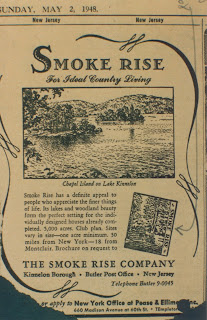
Smoke Rise 1948 advertisement
1948 advertisement
A casual survey of the proposed slope show it too steep for the limited area and with boulders and ledge outcroppings too expensive to clear. The idea never went beyond its concept in the mind of the map maker and would have had to sacrifice many of the best view lots to provide minimal facilities and safe novice runs. Whether or not the appeal of the prestigious skiing and private airfield stimulated sales-it didn't hurt.  The only plane to land was a Piper Cub that was forced down to refuel from a dump truck. The only sign of a plane, was the tail of a glider, owned by the female National Soaring Champion, waiting to be trucked to some area of rising currents (not available in Smoke Rise).  The only skiing was in back yards or open fields as an established facility was flourishing about two miles away as the crow flies.

Craigmeur has everything that would have had to be duplicated.  It was started in 1936 by Hugo Meury, the first ski run in the State of New Jersey and among the earliest in the U.S.A.  He found the best snow holding weather, with a northern exposure in the picturesque Alpine setting on Green Pond Road, Newfoundland.  Here he developed his slope grooming to such a refined point that he is credited with having pioneered the art.  He operated with varying success, depending on the snow fall until he sold out in 1955.  The new owners installed some of the first snow making equipment available anywhere in the world and sold out to the Murrays in 1965.  They lengthened the small private-like slope to 1,700 ft. and three more intermediate and beginner slopes.  A full services restaurant, cocktail lounge, cafeteria, ski shops and school with 65 instructors make it the largest learn-to-ski area in the State.

Nearby Snow Bowl started in 1963 on Weldon Road in Jefferson, attracted as many an 4,000 in one day before succumbing to over expansion and mismanagement in 1975.  It had a summit elevation of about 1,500 ft., a vertical drop of nearly 500 ft., with 7 runs and trails with a maximum run of about one half mile, served by two chair lifts, a T-bar and two rope tows. Many locals made their first runs under the direction of 25 instructors and went on to college ski scholarships.  One of these having worked all day, fell to sleep while operating the snow making machine, over night. He awakened to find a 10' x 50' monster ice whale that blocked the trail until it thawed out in the Spring.  Several moved to the other area operations, managing and coaching racing competitors and the equipment was purchased for the basic installation at Hidden Valley where one of them is manager and executive director of the New Jersey ski racing association.  The lodge burned down in the early 80s and the property is now part of the Mahlon Dickerson Reservation.

Page from original Smoke Rise Brochure
See below for Ski area related statement.
Hidden Valley, on Breakneck Road, Vernon, "was created for the skier who dislikes the elbowing crowds at other areas".  A "private club on weekends and holidays and open to the public with a limited ticket policy at all other times including seven nights a week" it is "committed to the needs of discriminating skiers". From a summit elevation of 1,400 ft and a vertical 700 ft. drop, it offers  twelve runs and trails, with two testing advanced expert runs and others for each degree of experience.  Its amenities include a restaurant, lounge, cafeteria, boutique, repair and rental shop, P.S.I.A. certified ski school, nursery and ski storage.  Among its present members, it has had several winners in the Eastern Regional Area Junior Competitions and now has a young teenage girl that shows every prospect of making the Junior Olympics.

Great Gorge started in 1964 and Vernon Valley in 1966, joined in 1977 after some misadventures and a "somewhat turbulent evolution" to become the largest ski complex between New York and Philadelphia and points south.  One of the largest in the North East, it spreads over three great mountains with a summit elevation of over 1,400 ft. and a vertical drop of 1,040 ft.  It is open from Thanksgiving to April, offering 53 slopes and trails for 25% novice, 45% intermediate and 30% expert, with 14 lifts including a high capacity triple chair and three rope tows.

It has the largest snow making system in the world, that can cover 8 miles of trails with several feet of snow, overnight.  This capability insures complete cover when nature fails to supply the normal blanket, which is still gratefully welcomed by skiers and owners.  The longest run, North East Passage, is 10,500 ft., a challenge for experts.  A calender of events attracts wide participation from "Michelob Ski Spree, Governors Cup Challenge", terminating with St. Patrick's special races that attract stellar performers.

The European atmosphere in the scenic Alpine surroundings is complemented by an authentic German Brewery, imported from Weisbaden.  Six restaurants, two pro shops, threee rental and repair shops and a bakery round out the services. A slope side condominium hotel, town houses and a fabulous Spa, together with Action Park summer attraction make it one of the finest four season recreation areas in the country.

The enticing programs offered by the local resorts, for the pre-school to the senior clientele is evidence of the increasing popularity of skiing. Only a few high school kids saw Morris Kinney in 1914, on his way to the Butler Rail Road Station, after the 5 mile trip from Smoke Rise, gliding smoothly over 2 ft. of snow on a pair of wooden slats. That afternoon, wooden barrels succumbed to the need for barrel staves, the local ski for years.
--------------------------
Pretty amazing!

Which of these ski resorts do you remember enjoying? Which was your favorite?


Please note that most of the links to the ski resorts that Cornie mentions go to sites that Liz Holste created and which include a multitude of photos and images relating to skiing in New Jersey.  

The reference on page 15 of the original Smoke Rise Brochures reads: "The Ski area is at the northerly end of Ski Trail which has just been opened." 

Note: Images courtesy of Tom Kline, Kinnelon historian.

P.S.:  This article about skiing in & around Smoke Rise and Kinnelon had me thinking about one of the very early episodes of Anthony Bourdain's show No Reservations about New Jersey in which he explores growing up in New Jersey...

Sunday, July 4, 2010

Didja Know? The Smoke Rise Inn

Didja Know?
Time for another article from Cornie Hubner's Didja Know?? Series. This one is about the Smoke Rise Inn. Consider it an introduction for a marvelous present day historic series about the Inn titled "If Walls Could Talk... The Smoke Rise Village Inn" that I will share with you in upcoming posts....

-------------------------

The Smoke Rise Inn

Originally published 11/15/1985

The early Smoke Rise brochures pictured a beautiful Club House and Inn, to be built on the Lake Shore near the beach.  Until its completion, space for Club activities would be available in the Barn Complex.  The renovated Stable, still showing the wall indentations for stalls (now the reception and cloak rooms), became the Dining Room, with a capacity of forty.  The present rear cocktail lounge was the slaughter house.  It had a huge fireplace (since remodeled) used to singe the carcasses of the farm-raised meats and became a cozy bar seating ten.  Both were unique.

The Inn opened in 1948 for the then twenty-five residents.  A French couple, previously employed at the Washington French Legation, in attractive uniforms provided a note of elegance that disguised the ancient kitchen and equipment that thwarted their culinary skills.  The setting was ideal for the salesman, who after a tour in his new Rolls Royce, further impressed his prospects with a demonstration of what they could enjoy.  Unfortunately, the $.50 sandwiches and $2.00 dinners, impeccably served, ceased when Mr. Talbot decided he could no longer subsidize the operation.

Smoke Rise Brochure: The Inn
After the French couple, a Housekeeper/Cook took over under the supervision of one of the sales staff. Several bedrooms were furnished on the second floor.  These, serviced by one Victorian bathroom, accommodated the members who wanted to view their home's construction.  Meals were prepared for the guests and a diminishing number of customers.

As membership increased at the rate of twenty to twenty-five families yearly, more space was needed for special events and Club activities.  A roof was built over the patio (now the bar) to connect with the low ceiling Carriage House.  Called the White Room, it was used for dances, social and club meetings and extending to the end of the building, it was the largest room available.  The Bull Pen, now the Cauldron Room, retained its original name and was used as a snack bar.  Building, remodeling and maintenance costs were reported to run up to $65,000 yearly.

The Early Smoke Rise Inn
In 1956, John Talbot opened the Inn with Chef Frank Milanasi from Col. Bradleys Beach Club of Palm Beach.  He hoped to start a trend for fine food.  Handicapped by the kitchen and a limited clientele, Frank became the first of a series of chefs like Tobin of the Chambord, one of the Sardi's, and a succession that failed to make it pay.

Finally, after almost seven years of inactivity, the Club faced a crisis - its liquor license would be lost unless business was resumed.  The purchase of the Inn Complex by the Club followed.  Plans for the additions, equipment and renovations were approved and all work was completed in 1981.

Cornie HubnerNo longer restricted by impossible conditions, and Seven Hundred families to serve, the grand opening was held in November, 1981.  Unfortunately, this ended in financial difficulties after four months.  In October of 1982 an agreement was reached with an experienced local couple to resume operations on a restricted basis. To a menu featuring a wide range of sandwiches, they added dinners, nicely served.  This was a menu that after nearly three years provided the transition to the current operation managed by "Beverly." [Note: Beverly Myers retired in 2009.]

Increased patronage enjoying the extended menu and occasional Brunch under the critical eye of Chef "Ronnie", has made the operation increasingly more profitable.  The outstanding facilities for Weddings, Parties, Conventions, etc., patronized by members and friends had added income that has reduced operating costs for the Club.

Improvements, as needed, will keep the facility one YOU can be proud to entertain in.  Think - it all took nearly 35 years.

--------------------------
Thank you, Christine Bell, for sharing a photo of Cornie Hubner.  For links to previous posts in the Cornie Hubner Didja Know? series, click on this link.

Please do stay tuned for "If Walls Could Talk... The Smoke Rise Village Inn" from Tom Kline.


Images of the Inn, courtesy of Tom Kline.

Sunday, April 25, 2010

Didja Know? Links to Cornie Hubner's Series

Didja Know? The Master File
Consider this post a master reference document with links to Cornie Hubner's Didja Know? articles.

As I get back to exploring Smoke Rise Newsletter archives in the Smoke Rise library, I'll add the original publish dates. And, as I publish more of Cornie's stories, I'll add them here, too.

"Didja Know?" by Cornelius A. Hubner

Didja Know? The Smoke Rise Club - originally published 7/15/1985

Didja Know? 1947 Smoke Rise Home Prices

Didja Know? Smoke Rise Royalty - originally published 9/1/1985

The First Home in Smoke Rise: Didja Know? - originally published 9/15/85


Didja Know? Trails

Didja Know? Kinnelon History

The Francis S. Kinney History Series:


The Smoke Rise Riding Club - Didja Know?


Related Posts Plugin for WordPress, Blogger...