Pages

Showing posts with label Kinnelon Critter File. Show all posts

Sunday, June 19, 2011

Kinnelon Little Critter File -- What Are They???

This spring at Emma's bus stop, actually in the the culvert pool next to the stop, which feeds the bog and the stream that runs along Sleepy Hollow, we found an odd orange swarming mass of some type of, well, larvae, I guess.

Kinnelon Little Critter File - Farthest Away
Farthest Away

Kinnelon Little Critter File - Medium distance
Medium distance

Kinnelon Little Critter File - Close-up
Close-up

At first we all thought they were rust, or brick dust, because of the bright color, but we could see on closer examination that they had legs and were moving, and actively. Their bodies were elongated and perhaps 1/8" or a little longer, with waving appendages.

They remained for about 5 days or so at the bottom of that pool and then dwindled rapidly over the course of a couple of days, finally to disappear.

What are they???

If they hadn't been somewhat sausage-like, I might have thought they were water mites, and if they had been a little more elongated I might think them to be midge larvae, which can both be orange, small, and present in the spring water runoff. But now, we do not know.

Does anyone?

They are pretty cool, though, and I'm sorry I did not scoop some up into a jar and take a look under a microscope. I did mean to. Ah, well ...

Yours in curiosity,

Ted and Emma


Photo Credit: Grace Mougalian

Saturday, April 9, 2011

Whitey Ford, Kinnelon's Albino Deer

Whitey Ford, Kinnelon's Albino Deer
Thank you for your comments on Emma's recent addition to the Kinnelon Critter File with her story about the Albino Deer. [We're a bit behind responding to them and appreciate your patience...]

The most exciting comment came from former Smoke Rise resident, Estelle Anderson [see New Pyramid Mountain Park Trail! and Needed: Split Rock Trail Maintainers For East Side].

Estelle shared with me the photo above of "Whitey Ford" and the following message:

Hi Christine, 

"Whitey Ford" as I used to call him, was there in Smoke Rise when I lived on Long Meadow Rd. Saw him around our property quite a bit with the rest of the herd. Here's my photo of him from 2004. I'm happy he's alive & well.

Here in West Milford, we had an albino fawn this past spring; saw it along with its sibling in proper deer tan and their mother.

Please do go ahead and share. It's really neat this guy survives!

See you on a trail someday!

Cheers!
Estelle Anderson

I already know that Chuck Mougalian will enjoy this story [I gave him a preview at the bus stop last Tuesday].  I expect that many of you will, too.

What are some of the 'Whitey Fords' you've come across recently? Leave me a comment or send me an email and I'll share it on the Smoke Rise & Kinnelon Blog!

Thank you, Estelle!

Added 4/10/11: I meant to include a link to this post titled Did You Hear About the White-Tail Deer? which includes frequently asked questions [e.g., how long do deer usually live? up to 10 years in the wild...]

If you are new to the blog and like what you read, consider subscribing to updates of the Smoke Rise & Kinnelon Blog via email or even RSS.

Sunday, April 3, 2011

Albino Deer: Kinnelon Critter File

Albino Deer: Kinnelon Critter File
In the latest Kinnelon Critter File entry, here is one about an Albino Deer

Reporting for this story is Emma Whittemore.

This Winter, Chuck Mougalian - a Smoke Rise neighbor - saw an Albino Deer in his backyard.  He said that it was living there for three weeks. Mr. Mougalian explained that this deer didn't look like the other deer. It was mostly white with some other markings.

Lots of people on Fox Ledge Road in Smoke Rise have seen the deer many times.

I was lucky one day when I saw it from my school bus stop, just up the hill from where we were standing.

Once my Mom and I saw an Albino Turkey.  At first I didn't know what it was, but then my Mom told me.

My friend told me that she has seen an Albino Hawk.

The Albino Deer lives in a herd of other deer with normal colors. Albino Deer are known to have some spots on them, but not always. The other deer don't hurt the Albino Deer. They don't really care if they are white. The deer treat it like any other deer.

Please tell us if you have seen any Albino Animals. We would love to know.

Thank you.


According to Buck Manager: All About Albino White-Tailed Deer, "only about one deer in 30,000 is an albino! However, not all white deer are true albinos. Some white whitetails have normally pigmented noses, eyes and hooves. In that instance, it would only be a genetic mutation for hair color but not other pigments." From the photo above, courtesy of Chuck Mougalian, this deer doesn't look to have pink eyes, so it may not be a true albino.

Here are a few other interesting articles I came across about Albino Deer:
Thanks, Chuck, for sharing your photo and story.

If you come across other Albino Animals, as Emma asks, please do let us know.

Friday, November 12, 2010

Coyotes In Our Community -- They're Here to Stay!

Coyotes In Our Community
Coyote in the "Light Phase" Color Doing Its Thing

We have coyotes in Kinnelon as permanent residents and we're going to have to come to terms with them! That's the message we took away from the Coyotes in Our Communities lecture given Monday, Nov. 8, 2010 at the Kinnelon High School, by the The NJ Department of Environmental Protection's Division of Fish & Wildlife.

In a fairly informal lecture with statistics and pictures with questions asked and answered afterwards, a moderate sized crowd was given a picture of the rise of the coyote population in NJ over the last 60 years, a bunch of facts, what to expect of coyotes, how to deal with them, and what the State of New Jersey's policy is toward coyotes.

First some facts:

For whatever reason, coyotes are new to New Jersey, and in fact the entire Eastern United States. They have pushed eastward from their traditional range in and around the Rocky Mountains in only the last hundred years or so. It's not a case of them having been hunted to extinction, and that they are now bouncing back, but simply that they are now able to expand in a way they have not been able to before.

The guesstimate of a population for coyotes in NJ is about 3,000 individuals, based on sightings, roadkill, diseased and/or dead animals reported, and hunter kills, which are legal during deer season, and which must be reported to the State within 24 hours of the kill.

The greatest density of animals is in the north and west of the State, and northern Morris County is in the high density area.
Depending on sex and age, adults vary size from 35 to about 50 lbs; they live less than 10 years in the wild, and perhaps as little as six.

Most coyotes do not make it to adulthood, but die before reaching the age of 1 and before they've learned enough to stay alive. They are hit by cars, taken by disease, and/or fail as hunters when they are pushed out of the family group at about 6 months of age.

Litters are produced in the spring, and only in the spring, and they are on their own by early fall. Which means that each adult pair produces a maximum of 6 new coyotes per year, most of which do not survive that first year.

Coyotes come in different colors or "phases" from from lightish beige and grey, to to a darkish charcoal color.

They have bushy tails which they hold still and down, unlike many dogs.

Their scat is somewhat dog-like but contains a lot of small bones and fur.

They do NOT hunt in packs and are not pack animals. Sightings of multiple animals are FAMILY sightings, which top out at around 8 animals, a typical litter of 6 and 2 parents.

They hunt small prey, considerably smaller than themselves, principally rodents such as rabbits, mice and voles, as well as birds, up to and including wild turkeys, and will consider small dogs up to about 20 lbs, and possibly even small children of a similar size, to be prey.

They are dusk and nocturnal hunters but not exclusively, and may be seen in daylight.

Coyotes ARE afraid of people and WILL give ground if charged or approached, if they are not cornered.

New Jersey has only 5 employees for the entire state to deal with larger animals, including mammals and birds, such as bear, deer, turkeys, owls, falcons, bobcats, and, yes, coyotes.

The state will not take any pro-active action against coyotes in any area, but will only address specific problems such as repeated taking of livestock, or attacks against people, because of a lack of NJ State resources, and because the experience of Western states has been that it has not been possible to eradicate, or even curtail the coyote population, even with the commitment of substantial public funds -- which NJ does not have.

That's about it for the facts I remember.

In remarks after the lecture itself, we were told that the best way to protect pets and children is to keep them inside, and not to let small dogs and children run free or far from adults when outside.

Incidents in other communities in NJ were discussed, just a very few over the last 50 years, involving attacks on people which led to the State's trapping of a specific animal which then ended the problem.

Several people expressed unhappiness over the State's policy and felt that NJ ought to do "something" about the coyotes, and 2 recounted tales of having their small dogs taken during a walk or from their backyards when their pets got a distance away from them, and were then grabbed by a coyote.

After a combined hour of lecture, slides and questions, the meeting was ended with thanks to the representative of NJ Fish and Wildlife and applause, as well as a few grumbles from those who wanted more to be done.

There you have it.

~Ted

Also see Kinnelon Critter File: Coyotes

Image courtesy of EnviroPolitics Blog.

Sunday, October 17, 2010

Kinnelon Critter File: Coyotes

Kinnelon Critter File: Coyotes
Coyotes have been in the news lately, particularly in Kinnelon where a coyote attacked and killed a Smoke Rise resident's dog in early October 2010. [In Rye, NY, they attacked a young girl in June and in July.] Notices of caution have started circulating which indicates that it's time for a Kinnelon Critter File on Coyotes!

Coyotes are not unique to our area; they have successfully established themselves throughout the Unites States, including suburbia and even Central Park NYC.  A search on 'coyotes' will bring up web pages on Living With Coyotes in Massachusetts, Montgomery, AL, Southwest Desert USA and more.

[From New Jersey's Great Northwest Skylands, read Coyotes in New Jersey: The Life of Wiley.]

Per MassWildlife:

"Coyotes are the size of a medium-size dog, but with longer, thicker fur. Coyotes have a long, bushy, black-tipped tail that is usually carried pointing down. A coyote is typically 4-5 feet in length, from snout to tip of tail. Their snout is long and slender, and their ears are pointed and erect. The pelts of coyotes in Massachusetts range from grayish-black to blondes, light tan, dark tan, red or even all black. Females weigh an average of 33-40 lbs and males are slightly larger (average 34-47 lbs)."

"They can be active night or day, and sightings at dawn or dusk are common. They remain active all year-round and do not hibernate. Once a coyote has established itself into an area, it will actively maintain a territory that may vary in size from 2 to 30 square miles. One family of coyotes often encompasses one or more residential suburban areas or towns. Coyotes are highly territorial..."

They will eat carrion, but prefer fresh meat. They are valuable in controlling rats, squirrels, and woodchucks. In addition to small animals, they eat fruit and vegetables, pet food and GARBAGE!

[By the way, now I know what role T. Llama plays with the sheep at Four Corners: he guards them against coyotes... although probably not against bears.]

Interestingly, many of the recommendations for protecting oneself from coyotes are the same as for bears. Here is what NJDEP Division of Fish and Wildlife suggests on how to deal with coyotes:

  • Never feed a coyote. Deliberately feeding coyotes puts pets and other residents in the neighborhood at risk [this seems like a no brainer to me; then again some people try to feed bears].

  • Feeding pet cats and/or feral (wild) cats outdoors can attract coyotes. The coyotes feed on the pet food and also prey upon the cats.

  • Put garbage in tightly closed containers that cannot be tipped over.

  • Remove sources of water, especially in dry climates.

  • Bring pets in at night. Coyotes view cats and small dogs as food and larger dogs as competition [remember, coyotes and dogs are related and can breed].

  • Put away bird feeders at night to avoid attracting rodents and other coyote prey.

  • Provide secure enclosures for rabbits, poultry, and other farm animals.

  • Pick up fallen fruit and cover compost piles.

  • Although extremely rare, coyotes have been known to attack humans. Parents should monitor their children, even in familiar surroundings, such as backyards.

  • Install motion-sensitive lighting around the house.

  • Clear brush and dense weeds from around dwellings - this reduces protective cover for coyotes and makes the area less attractive to rodents and rabbits. Coyotes, as well as other predators, are attracted to areas where rodents are concentrated, such as in woodpiles.

  • If coyotes are present, make sure they know they're not welcome. Make loud noises, blast a canned air siren, throw rocks, or spray them with a garden hose.  Per MassWildlife: "Don't let coyotes intimidate you! Don't hesitate to scare or threaten coyotes with loud noises and bright lights. Don't hesitate to pick up small objects, such as a tennis ball, and throw them at the coyote. If a water hose is close at hand, spray the coyote with water in the face. Let the coyote know it is unwelcome in your area."


  • Finally, if you observe coyotes in the daytime that show no fear of humans or if a coyote attacks a person, immediately contact your local police and the Division of Fish and Wildlife at 908-735-8793; outside of normal business hours call the DEP Hotline at 877-WARN-DEP.

    The Smoke Rise Newsletter recently issued the following guidelines:

    Be aware of where your children are when outside. Never leave them unattended.

    Do not let your dog outside day or evening without supervision or on a leash. Small dogs are particularly vulnerable to predators, but a predator can attack a larger dog just as easily if circumstances allow. Invisible fencing does not stop an animal from coming onto your property. 

    Cats are very vulnerable to predators. Many cats have been reported missing in Smoke Rise alone this summer and coyotes are assumed to have been the reason. PLEASE do not let your cat outside. In addition to the chance of being bitten by any number of wild animals, your cat may expose your household to disease. 

    If you see a coyote, call the Kinnelon Police [and Smoke Rise Security if you live in Smoke Rise] stating date and time of day.

    Here are links to a few other coyote resources:

    Coyote FAQs from DesertUSA
    Wikipedia entry on Coyotes
    From the New York Times, Mysteries That Howl and Hunt

    If you know of other resources or recommendations for dealing with coyotes, please let me know or add them in the comments section.

    Be safe!


    Coyote Image courtesy of Coyotes in Montgomery.

    Saturday, May 29, 2010

    Kinnelon Critter File: Foxes

    New Jersey Red FoxSmoke Rise neighbor Chuck Mougalian shares these photos of Kinnelon foxes hanging out, appropriately enough, on Fox Ledge Road in Kinnelon for the Kinnelon Critter File.

    According to Chuck, he has noticed this fox every day for the past week or so in the neighborhood.

    From the pictures, the fox looks to be a red fox [vulpes vulpes], one of two New Jersey fox species.

    Interestingly, foxes aren't the largest of critters. From Foxes in New Jersey - published by the New Jersey Division of Fish & Wildlife - they range from 8 to 15 pounds -- not too far from what my cats weigh on the low end.

    They are crepuscular critters, active early or late in the day.

    Now, I have declared war on groundhogs and am delighted to discover that foxes will consume groundhogs [or woodchucks] and might even take over their dens. Only seems fair. And they don't even eat your flowers.... unlike woodchucks.

    Kinnelon Critter File: FoxesI'm curious. Have you encountered foxes? Emma and I once caught sight of one toward the extension of the Pyramid Mountain trail. That was a few years ago.

    Have you seen any lately? What have you observed in terms of habits?

    I'd love to hear your about what you've observed.

    Thank you, Chuck, for sharing these photos.


    Added 6/1/10: Here is a link to other entries in the Kinnelon Critter File. If you come across other critters, please don't hesitate to let me know!

    Sunday, December 13, 2009

    Kinnelon Critter File: Beavers

    Beaver at the Frank R. Lautenberg Visitor Center

    Kinnelon Beavers


    Were you aware that beavers are plentiful in Kinnelon? Particularly around our lakes and ponds.

    We had our first live beaver encounter a few weeks ago traveling west on Fayson Lakes Road across the Kakeout Reservoir causeway.

    It was 9:30 at night. I was driving and I noticed a large dark critter to my left. It was raccoon-like but larger. It was groundhog-like, too, but larger. Neither made sense given the water on both sides of the road. Furthermore, the critter was wet.

    Then we noticed another large shape on the right side of the road, unfortunately dead, and realized that we had encountered our first live beaver, concerned about its mate. You see, beavers mate for life.

    National Geographic has a fascinating site on beavers. It includes a 30 second audio clip on how beavers sound and a video [caution: the video forces you through an ad at the beginning and end]. Beavers are large rodents weighing approximately 60 pounds.

    beaver activity at beaver dam pond in Kinnelon, NJThe Wikipedia entry on beavers includes a cross-section of beaver lodges and a terrific photo of a beaver tail. Check out the webbed feet, too.

    We noticed our first sign of beaver activity on the Beaver Dam And Charlotteburg Road Hike. Not only a dam in the middle of the pond, but also plenty of trees chopped down by the critters as you can see from the photo above.

    Lake Kinnelon has seen more beaver activity lately as has Hoot Owl Pond, and trees around both are now protected by mesh.

    As plentiful as they may be in our midst, beavers are also elusive. I'm my dreams I can imagine hiking down to the Beaver Dam to catch a glimpse of them before dawn. Reality has me ensconced comfortably in bed instead.

    Seeing this beaver was a treat. I now find myself slowing down along the Fayson Lakes causeway, not just to absorb the view, but also in case a beaver is swimming within view.

    Do you have beaver stories to share?

    PS: If you travel that route at night, I urge caution in case you encounter a beaver in the road.

    Sunday, August 30, 2009

    Kinnelon Critter File: New Jersey Black Bears

    Black BearsSome of what makes living in Kinnelon, NJ so magical has to do with the animals we cohabitate with. Take the largest of these critters: the New Jersey Black Bear - actually the American Black Bear. Did you know that not only has it been seen in all New Jersey counties, but it also ranges throughout most of North America?

    Since moving into this area in 2004, we have had many opportunities to observe and admire, but also respect, these magnificent animals. After all, they are beautiful, but also big, bigger than me and bigger than my daughter.

    NJ Black BearBest then to try to understand this animal, how to minimize negative encounters and how to behave in case of encounters.

    If you get the opportunity, do attend the session that the New Jersey Division of Fish and Wildlife offers every other year or so at the Kinnelon Borough Hall. I missed the most recent one, but my daughter and I attended the previous session and learned from it.

    Because, particularly at certain times of the year - early Spring through late Summer - our New Jersey Black Bears are busy. Eating, foraging, wandering... They love skunk cabbage so be on the lookout when you hike by wetlands and bogs.

    Black Bears are curious and quite agile. We have observed from inside our house a momma and two cubs climbing over a cyclone fence, to peer into our neighbor's window, and then go off toward another neighbor.

    We once discovered our very heavy BBQ pulled away from the house - because a very large animal had smelled the grease pan we had forgotten to empty. Bears' sense of smell is acute.

    And, we've noticed them religiously visiting trash dumpsters and trash cans, to drag off into the woods any tempting loot. I'm sure you've seen the telltale trails of debris.

    Don't feed NJ Black BearsGiven that we truly live in bear territory, here are a few of the bear facts that the NJ Division of Fish & Wildlife offer on the "Know The Bear Facts" website.

    First, use common sense. These are WILD animals, not cute, cuddly critters. So, don't approach them and don't try to feed them!

    When you are outdoors, be loud. If it's getting dark and I'm alone getting the mail from my mailbox, I sing badly and loudly.

    If bears are close by, "make the bear aware of your presence by speaking in an assertive voice, singing, clapping your hands, or making other noises."

    "Make sure the bear has an escape route."

    "If a bear enters your home, provide it with an escape route by propping all doors open."
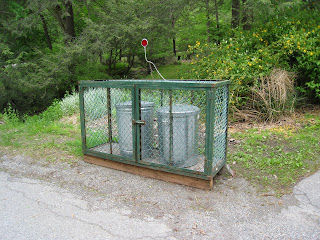
    bear proof garbage cagesAs it relates to your own home:

    + Close your garage doors.

    + At night, close your ground level windows. I assure you that a screen will not keep a curious and agile critter [if not bear, then think raccoon] out of your house.

    + Protect your garbage cans. Keep inside your garage the smelly-bear-desirable trash and put it out for collection at the last possible moment. Or, consider these garbage cages I discovered around Sterling Forest properties.

    + Forget about bird feeders.

    [BTW, be sure to close car windows at night, particularly if there's any kind of food or food wrappers inside. Otherwise, you might be surprised to find that visitors have come by.... Raccoon or otherwise!]

    "Avoid direct eye contact and never run from a bear. Instead, slowly back away."
    NJ Black Bear"To scare the bear away, make loud noises by yelling, banging pots and pans or using an airhorn. Make yourself look as big as possible by waving your arms. If you are with someone else, stand close together with your arms raised above your head."

    "The bear may utter a series of huffs, make popping jaw sounds by snapping its jaws and swat the ground. These are warning signs that you are too close. Slowly back away, avoid direct eye contact and do not run."

    "If a bear stands on its hind legs or moves closer, it may be trying to get a better view or detect scents in the air. It is usually not a threatening behavior."

    "Black bears will sometimes "bluff charge" when cornered, threatened or attempting to steal food. Stand your ground, avoid direct eye contact, then slowly back away and do not run."

    "If the bear does not leave, move to a secure area."
    NJ Black BearDuring the NJDEP presentation, we were told never to play dead around the New Jersey Black Bear. Make noise, and lots of it, instead.

    And, don't leave your children or small pets outside unsupervised.

    Read through the Bear Facts website, check out Black Bear Safety Techniques, don't ever feed the bears - it's illegal in New Jersey! - and educate yourself. There's real magic to having bears around -- at a safe distance.

    And, as long as they don't associate you or your home with food, they will remain at a safe distance. Hence the law to not feed the bears.

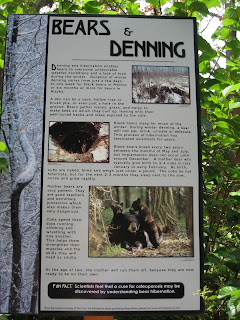
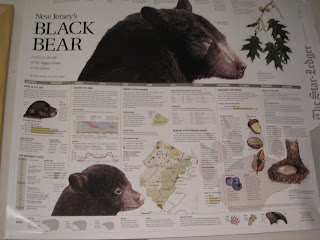
    To learn more about the New Jersey Black Bear, consider visiting Pyramid Mountain Park and speaking with the rangers. The Visitors Station also has nice displays [e.g., see the Black Bear poster image above].

    Another resource is the Turtle Back Zoo from which the other four poster images above come from. If you go there, you can meet Jelly and Jam, two New Jersey Black Bears.

    Now, there's plenty of controversy surrounding Black Bears in New Jersey. Suburban Trends reported on Serious bear incidents more than double in 2008 [2/17/2009]. In researching this Kinnelon Critter file, I discovered the NJ Bear Hunt Blog, about the need for dealing with bear overpopulation issues. The Bear Education and Resource Group vehemently opposes a hunt solution recommending instead aversive bear conditioning [I'm thinking that someone may be receiving a supersoaker water gun for his birthday...].

    What other bear tips do you recommend?


    Technorati Tags: Del.icio.us Tags:

    Saturday, March 28, 2009

    Kinnelon Critter File: If You Meet A Mountain Lion

    eyes of a mountain lion originally uploaded
    by Shoeless Joe/64.
    Before you say "phooey! a mountain lion?" please read on.

    According to the front page of the 4/1/09 issue of The Smoke Rise Club News:

    "There is also this cat. Last fall over a period of several weeks Security received numerous calls from residents about a "big" cat they had seen on their property. While we felt these calls were credible we were unable to locate this animal and could find no proof that would satisfy the New Jersey wildlife officials of its existence. The reports of "big" cat sightings soon stopped. That was last fall and now with the coming of spring one of our Security patrol officers has seen the animal on Pepperidge Tree Terrace. This is not a domestic cat or a bobcat. This is a brown female cat with a long tail probably weighing close to 100 pounds."

    Now, perhaps you read our previous post The Kinnelon Critter File: Mountain Lion or Large Bobcat. We weren't aware of it at the time, but it sure sounds like our pawprints belong to the critter that other residents saw. Which means that it's highly likely that there's a large feline about.

    I can deal with it. Really.

    Realistically, though, I know I can't hide out in my house for the rest of my life. So, how do I prepare for the worst case scenario? How do I react should I come face to face with this large feline? Is there a protocol as there is with bears?

    Here's what I've learned:

    From the Arizona Game and Fish Department:

    + Do not approach the animal. Most mountain lions will try to avoid a confrontation. Give them a way to escape.

    + Stay calm and speak loudly and firmly.

    + Do not run from a mountain lion. Running may stimulate a mountain lion’s instinct to chase.

    + Stand and face the animal. Make eye contact. [Note: for a bear, do NOT make eye contact.]

    + Appear larger. Raise your arms. Open your jacket if you are wearing one. Throw stones, branches, or whatever you can reach without crouching or turning your back. Wave your arms slowly. The idea is to convince the lion that you are not easy prey and that you may be a danger to it.

    + Maintain eye contact and slowly back away toward a building, vehicle, or busy area.

    + Protect small children so they won’t panic and run. [Note: children are vulnerable.]

    + Fight back if attacked. Many potential victims have fought back successfully with rocks, sticks, caps, jackets, garden tools, their bare hands, and even mountain bikes. Since a mountain lion usually tries to bite the head or neck, try to remain standing and face the animal.

    According to Mammoth Lakes, CA City Concierge, avoid being out and about at dawn and dusk when mountain lions tend to hunt. In addition,

    Recognize threatening mountain lion behavior. There are a few cues that may help you gauge the risk of attack.

    + If a mountain lion is more than 50 yards away, changes positions, directs attention toward people, and exhibits following behavior, it may be only curious. This circumstance represents only a slight risk for adults, but a more serious risk to unaccompanied children. At this point, you should move away, while keeping the animal in your peripheral vision. Also, take out a deterrent device or look for rocks, sticks, or something to use as a weapon- just in case.

    + For distances of less than 50 yards, where the animal is staring intensely and hiding, it may be assessing the chances of a successful attack. If intense staring and hiding continue, accompanied by crouching and creeping, the risk of attack may be substantial.

    How Not to Get Eaten by a Mountain Lion offers intriguing advice for bicycle riders, which - I would think - works for hikers. No?

    This is in no way meant to alarm. Simply to prepare.

    Except for the eyes, the steps to take are similar to those you take if you encounter a bear. I keep a pocketful of New Year's noise makers readily available in my backpack when we hike. I never hike alone. I also sing really badly and loudly when I put the trash out at night. That should deter any proper Kinnelon critter.

    If you know of other steps to take, please let me know so I can include them here.


    Technorati Tags: Del.icio.us Tags:

    Wednesday, November 26, 2008

    Kinnelon Critter File: Wild Turkeys

    Wild Turkeys in Paterson, NJ originally uploaded by Brooklyn Bridge Baby.
    It certainly seems appropriate for Thanksgiving to share with you another installment of the Kinnelon Critter File. This time, it's the story of Wild Turkeys.

    I bet you've noticed groups of 5 to 8 turkeys - sometimes more - foraging about through the forested areas, perhaps even trekking through your property.  Earlier in the spring, I remember seeing an all-white turkey.  I haven't seen her lately, but I'm sure she's about somewhere.

    Per Wikipedia, Wild Turkeys are native to North America.It seems that in Kinney's time [i.e., early 1900s] the turkey population was as low as 30,000.  Today, it is closer to 7 million birds.

    Wild turkeys are omnivores, occasionally eating frogs and snakes. [I thought they only consumed nuts, grubs, seeds and berries...]  Another interesting fact:  did you know that turkeys' "heads and necks are colored brilliantly with red, blue and white. The color can change with the turkey's mood, with a solid white head and neck being the most excited."  I think this refers primarily to male turkeys.

    Another source of Turkey tidbits is Cornell University's All About Birds: Wild Turkey summary which includes a recording of turkey calls. 

    Did you know that Benjamin Franklin wished the Turkey were the national bird over the eagle? He considered turkeys more noble...

    With that, I hope you consume your domestic turkey with renewed respect and appreciation for the Wild Turkey.

    Happy Thanksgiving!


    Technorati Tags:   Del.icio.us Tags:  

    Saturday, November 22, 2008

    Kinnelon Critter File: Swans

    Other than admiring their grace and serenity in watery settings, I know very little about swans. We are fortunate, though, in the Kinnelon, NJ area to have many to admire.

    I counted approximately ten on Fayson Lakes recently, and two on the Taylortown Reservoir next to the Boonton Avenue and Fayson Lakes Road soccer field.  I was delighted to notice a growing family on Woodland Lake in Pompton Plains, too.

    The three that delight me the most live on Lake Kinnelon.  I share them with you here, as well as what I've recently discovered about swans.

    Swans took on a more romantic aura after reading E.B. White's The Trumpet of the Swan this spring with my daughter [thanks to her teacher, Dawn Winkler].  From that book, we learned about Trumpeter Swans, the "largest native North American bird, if measured in terms of weight and length, and is (on average) the largest waterfowl species on earth."  We started paying closer attention to the swans in our vicinity, wondering about the eggs being laid and hatched and the viability of the cygnets. 

    We didn't think ours were Trumpeters, but we hadn't had much of a chance to inspect them closely enough to reach any kind of scientific determination.

    Until we decided on a beautiful late September weekend to take the Lake Kinnelon hike and came across the swans at the far north and shallow end of the lake.  Needless to say, we got out of the car, camera in hand and made sure to capture these critters digitally.

    Thanks to the photos, we've been able to determine which swans ours are.

    In addition to Trumpeter Swans, there are also Tundra Swans and Mute Swans in the U.S.. Trumpeters and Tundras are native, whereas Mutes were introduced from Europe.  Based on the orange bill color and body posture, we have determined that the swans in our area are Mute Swans.

    Despite its name, the swan makes noises.  "Although quieter than some other species, it is by no means mute. Among its vocalizations are a loud snort when annoyed, shrill trumpeting when really angry, and an aggressive hiss. They are the most territorial of the swans and two males will fight viciously if one intrudes on another's turf. Nesting territories can cover 4-10 acres and are reoccupied by the same pair year after year. In breeding season they can be quite aggressive to people approaching the nesting area, and their large size makes them somewhat dangerous in this situation, so it is best to avoid them at that time" says FeatherSite.


    Earlier, I mentioned that Mute Swans aren't native to the U.S..  In fact, they were introduced to this country in the late 1800s from Western Europe, mostly in the Hudson Valley and Long Island sections of New York State primarily for decoration, to enhance water properties and zoos.  

    Possibly a far stretch, but I wonder whether Francis Kinney might have acquired his own pair of Mute Swans?  Perhaps these are the descendants?

    According to the Columbia write-up on Mute Swans, "Mute swans are herbivorous aquatic foragers. An individual adult swan consumes 3-4kg of submerged aquatic vegetation (SAV) per day.  The remainder of their diet includes a small proportion of terrestrial plants, algae, insects, fish and frogs.  In their native lands, mute swan feeding habits aid other waterfowl’s foraging as they stir up vegetation deep in the water that smaller waterfowl, such as ducks, cannot reach.  If left unprotected, medium-sized predators, such as mink and raccoons, will take eggs and cygnets.  Adults are not usually preyed upon unless they are injured or sick."

    Early Autumn view of St. Hubert's Chapel.
    The different sites referenced above touch on the destructive nature of Mute Swans and the need for concern.  Although I envy Fayson Lakes its large swan population, Lake Kinnelon's population seems better controlled. From what the Smoke Rise Beach life guards have said, we owe thanks to the lake's snapping turtles which prey upon the eggs and cygnets [baby swans]...  The current Lake Kinnelon swan family consists of the parents [cob and pen] and possibly a youngster from last year's clutch as it is all white with orange beak [adolescents are grey with black beaks]. 

    Do let me know if you notice other swans or other types of swans nearby.

    [Last weekend, we visited the Central Park Zoo and came across a black-necked swan from South America.  I'll share that with you in a separate post.]


    Saturday, October 4, 2008

    The Kinnelon Critter File: Mountain Lion or Large Bobcat?

    One recent dark rainy Smoke Rise evening, we had a visitor to our porch.  Although silent, our visitor left tracks that looked both familiar and eerily different...

    So different that I ran for my camera and called to my husband to get a tape measure.

    Our three domestic cats were inside, fast asleep.  
     
    The tracks impressed us.  No claws meant that these weren't dog tracks.  We checked, although we knew from having seen our own cats' footprints that these were feline.

    Furthermore, the only prints were at the top of the porch which meant that the animal had jumped up rather than taken the steps as a dog would have.   

    Their size was truly impressive.  From the bottom of the pad to the opposite toe, these tracks measured 3 inches each.  Not your average house kitty cat paw print size, which is closer to .5 to 3/4 of an inch.  What could this visitor be?

    Mountain Lion paw print courtesy of iStockphoto
    I consulted the animal track reference books from the Pyramid Mountain Park visitors' center. The characteristic scallop at the rear of the main pad and the radial toe placement indicated that the most relevant and closest animal - per the guide - was either Bobcat or Mountain Lion... three inches being at the very top of the range for a bobcat, and just a little small for a mature mountain lion.

    Per our daughter's classmate's dad, we learned that mountain lions have been spotted in the area, one possibly even on the soccer field.

    Interestingly, last weekend's 9/28/08 New York Times article titled The Preservationists' Trails by Christopher Brooks refers to bears and an elusive bobcat, but no mountain lion in the Pyramid Mountain Park vicinity.  It's still definitely worth a read.

    For example, did you know that Pyramid Mountain Park encompasses more than 20 miles of trails "encompassing two significant hilltops [i.e., Pyramid Mountain and Turkey Mountain] and some of the most impressive boulder fields and glacial debris in the region, this park is hard to beat."

    At the same time, I was stunned to learn that the park almost never came to be. A touch over 20 years ago, both mountains were ear-marked to be quarried - similar to what you see at exit 52 of 287 South.

    Imagine losing such gems as Bear Rock and Tripod Rock, two huge boulders — "granite erratics left behind by the retreating Wisconsin glacier some 20,000 years ago" — that lie alongside the trial on the Pyramid Mountain side. And, on the Turkey Mountain side, trails pass by the remains of mid-19th century quarries, "the great birding by Botts Pond, which is frequented by indigo buntings, scarlet tanagers and various warblers, there is a crackling waterfall that drops about a dozen feet and a couple of atmospheric cabin ruins (festooned in spring with colorful columbine) atop the namesake peak.

    Just think, all of this only 35 miles from midtown Manhattan, New York City! That's what makes this part of Northern New Jersey so very magical, including the Kinnelon critters.


    Added 10/6/08 - I've just come across these other references:
    + From The New York Times, Deer Draw Cougars Ever Eastward, dated 11/12/2002 by Blaine Harden
    + Commenting on that article, Cronaca with copious commentary from New Jersey-ites...
    Related Posts Plugin for WordPress, Blogger...